


Feel free to ask us anything about us or our offerings. Think of this agent as your personal consultant.


AI-Powered Business Solutions
The Agent Layer:
The Agent Layer:
The Agent Layer:
How AI Changes Software Lock-In, Data Value, and Competitive Advantage
Op-Ed
Op-Ed
10 min reading
10 min reading
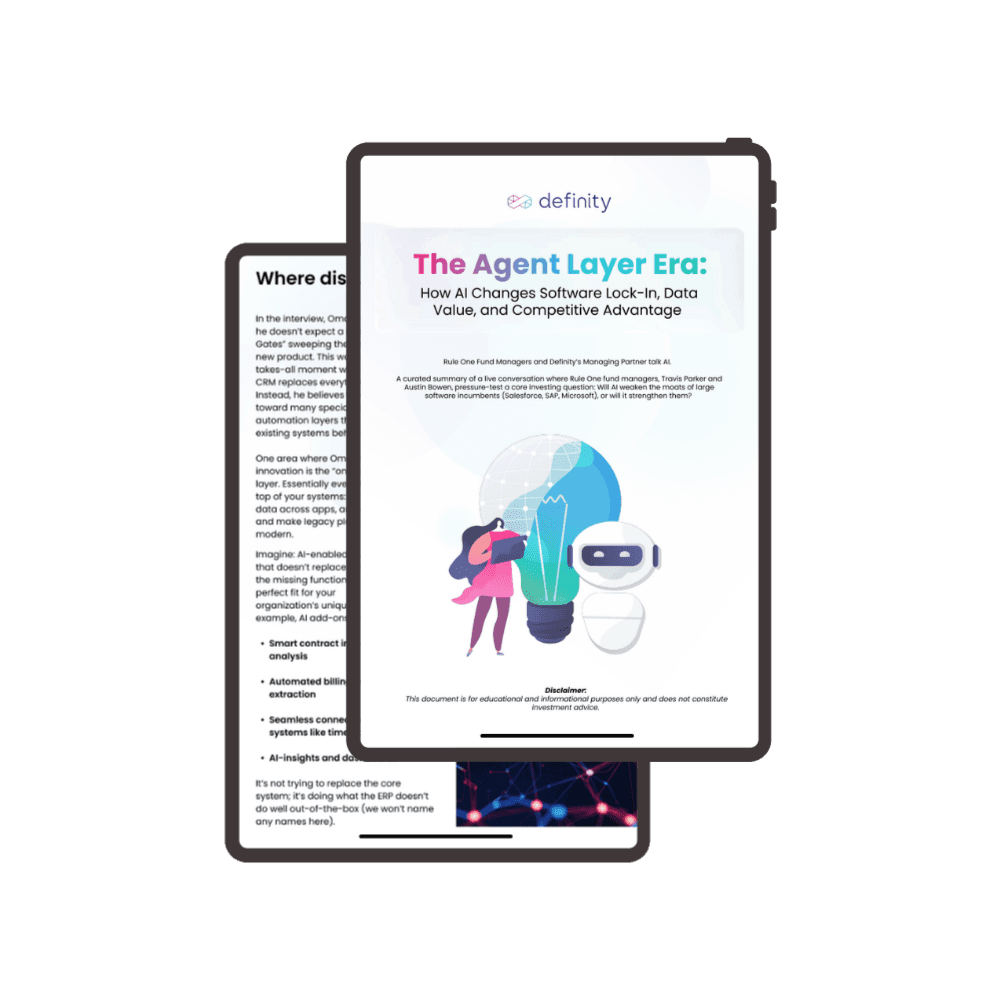

Share


Portfolio managers, Travis Parker and Austin Bowen, from Rule One Fund shared an analogy that’s circulating in markets: AI could do to major software incumbents (Salesforce, SAP, Microsoft) what YouTube did to legacy media—making it cheap for new “creators” to compete and decentralizing who wins.
Omar Del Rio, Definity’s Managing Partner, shares a more nuanced view:
AI will accelerate software creation, but it won’t instantly dethrone incumbents. The hardest part of software isn’t generating code, it’s product-market fit and understanding what users actually need.
The near-term disruption is “on top of” existing systems, not ripping them out. Rather than replacing ERPs/CRMs, the biggest wave will be AI products that connect to what you already use and automate workflows that those systems don’t handle well.
The compounding advantage is data + embedded business rules. Big platforms remain sticky because they contain years of business logic and operational history. Proprietary business data increasingly becomes the advantage AI can’t easily copy.
Disclaimer: This document is for educational and informational purposes only and does not constitute investment advice.
Portfolio managers, Travis Parker and Austin Bowen, from Rule One Fund shared an analogy that’s circulating in markets:
AI could do to major software incumbents (Salesforce, SAP, Microsoft) what YouTube did to legacy media—making it cheap for new “creators” to compete and decentralizing who wins.
Omar Del Rio, Definity’s Managing Partner, shares a more nuanced view:
AI will accelerate software creation, but it won’t instantly dethrone incumbents. The hardest part of software isn’t generating
code, it’s product-market fit and understanding what users actually need.
The near-term disruption is “on top of” existing systems, not ripping them out. Rather than replacing ERPs/CRMs, the biggest wave will be AI products that connect to what you already use and automate workflows that those systems
don’t handle well.
The compounding advantage is data + embedded business rules. Big platforms
remain sticky because they contain years of business logic and operational history.
Proprietary business data increasingly becomes the advantage AI can’t easily copy.
Disclaimer: This document is for educational and informational purposes only and does not constitute investment advice.
Portfolio managers, Travis Parker and Austin Bowen, from Rule One Fund shared an analogy that’s circulating in markets: AI could do to major software incumbents (Salesforce, SAP, Microsoft) what YouTube did to legacy media—making it cheap for new “creators” to compete and decentralizing who wins.
Omar Del Rio, Definity’s Managing Partner, shares a more nuanced view:
AI will accelerate software creation, but it won’t instantly dethrone incumbents. The hardest part of software isn’t generating code, it’s product-market fit and understanding what users actually need.
The near-term disruption is “on top of” existing systems, not ripping them out. Rather than replacing ERPs/CRMs, the biggest wave will be AI products that connect to what you already use and automate workflows that those systems don’t handle well.
The compounding advantage is data + embedded business rules. Big platforms remain sticky because they contain years of business logic and operational history. Proprietary business data increasingly becomes the advantage AI can’t easily copy.
Disclaimer: This document is for educational and informational purposes only and does not constitute investment advice.
The YouTube analogy.
The YouTube analogy.
History is filled with epic disruption stories where technology doesn’t just improve an industry, it rewrites the rules of who gets to win. Blockbuster didn’t lose because people stopped watching movies; it lost because Netflix changed the model (on-demand, personalized, always available) while Blockbuster stayed anchored to a world of late fees and physical inventory. And YouTube didn’t beat traditional media by making better TV, it blew up the idea that you needed a studio, a broadcast schedule, or a distribution deal just to reach an audience. In both cases, the “giants” weren’t taken out by a single feature, but rather a structural shift: access got cheaper, distribution got democratized, and the bottlenecks that used to protect incumbents disappeared.
History is filled with epic disruption stories where technology doesn’t
just improve an industry, it rewrites the rules of who gets to win. Blockbuster didn’t lose because people stopped watching movies; it lost because Netflix changed the model (on-demand, personalized, always available) while Blockbuster stayed anchored to a world of late fees and physical inventory. And YouTube didn’t beat traditional media by making better TV, it blew up the idea that you needed a studio, a broadcast schedule, or a distribution deal just to reach an audience. In both cases, the “giants” weren’t taken out by a single feature, but rather a structural shift: access got cheaper,
distribution got democratized, and the bottlenecks that used to protect incumbents disappeared.

Here’s what Omar had to say:
“Although the analogy is useful, it’s incomplete. YouTube was a shift in distribution where legacy media once acted as “gatekeepers.” YouTube removed that bottleneck, so talent could reach audiences directly. Software distribution, on the other hand, differs because it was already open and competitive - anyone can ship an app; disruptions have been happening for years.”
Here’s what Omar had to say:
“Although the analogy is useful, it’s incomplete. YouTube
was a shift in distribution where legacy media once acted as “gatekeepers.” YouTube removed that bottleneck, so talent could reach audiences directly. Software distribution, on the other hand, differs because it was already open and competitive - anyone can ship an app; disruptions have been happening for years.”
Here’s what Omar had to say:
“Although the analogy is useful, it’s incomplete. YouTube was a shift in distribution where legacy media once acted as “gatekeepers.” YouTube removed that bottleneck, so talent could reach audiences directly. Software distribution, on the other hand, differs because it was already open and competitive - anyone can ship an app; disruptions have been happening for years.”
Here’s what Omar had to say:
“Although the analogy is useful, it’s incomplete. YouTube was a shift in distribution where legacy media once acted as “gatekeepers.” YouTube removed that bottleneck, so talent could reach audiences directly. Software distribution, on the other hand, differs because it was already open and competitive - anyone can ship an app; disruptions have been happening for years.”


There’s a popular mantra going around the industry: “Code is cheap.” Tools like Claude Code and Replit have made it faster and easier to spin up working software, prototype ideas, generate boilerplate code, and iterate without the same headcount or timelines that were
required.
Omar explains that while the “code is cheap” mantra
is real, it is also an oversimplification because the real cost of enterprise software was never just producing lines of code. AI compresses build cycles, but it does not automatically solve user needs, user experience, adoption, or product market fit. Incumbents, especially in the mid-market and
enterprise spaces, will remain resilient because of embedded business rules and complexity. Even “painful” software like SAP still gets bought because it encodes years of operational reality.
There’s a popular mantra going around the industry: “Code is cheap.” Tools like Claude Code and Replit have made it faster and easier to spin up working software, prototype ideas, generate boilerplate code, and iterate without the same headcount or timelines that were required.
Omar explains that while the “code is cheap” mantra is real, it is also an oversimplification because the real cost of enterprise software was never just producing lines of code. AI compresses build cycles, but it does not automatically solve user needs,
user experience, adoption, or product market fit. Incumbents, especially in the mid-market and
enterprise spaces, will remain resilient because of embedded business rules and complexity. Even “painful” software like SAP still gets bought because it encodes years of operational reality.
There’s a popular mantra going around the industry: “Code is cheap.” Tools like Claude Code and Replit have made it faster and easier to spin up working software, prototype ideas, generate boilerplate code, and iterate without the same headcount or timelines that were required.
Omar explains that while the “code is cheap” mantra
is real, it is also an oversimplification because the real cost of enterprise software was never just producing lines of code. AI compresses build cycles, but it does not automatically solve user needs, user experience, adoption, or product market fit. Incumbents, especially in the mid-market and
enterprise spaces, will remain resilient because of embedded business rules and complexity. Even “painful” software like SAP still gets bought because it encodes years of operational reality.
Where disruption shows up first.
Where disruption shows up first.
In the interview, Omar says he doesn’t expect a single new “Bill Gates” sweeping the industry with one new product. This won’t be a winner takes-all moment where one new ERP/ CRM replaces everything overnight. Instead, he believes the shift is toward many specialized products and automation layers that change how existing systems behave.
One area where Omar expects outsized innovation is the “on top of your stack” layer. Essentially everything that sits on top of your systems: tools that connect data across apps, automate workflows, and make legacy platforms feel modern.
Imagine: AI-enabled invoicing that doesn’t replace the ERP
but adds the missing functionality to make it a perfect fit for your organization’s unique needs. For example, AI add-ons could help with:
Smart contract ingestion and analysis
Automated billing scheduling extraction
Seamless connection to external systems like time tracking/inventory
AI-insights and dashboards
It's not trying to replace the core system; it’s doing what the ERP doesn’t do well out-of-the-box (we won’t name any names here).
In the interview, Omar says he doesn’t expect a single new “Bill Gates” sweeping the industry with one new product. This won’t be a winner takes-all moment where one new ERP/ CRM replaces everything overnight. Instead, he believes the shift is toward many specialized products and automation layers that change how existing systems behave.
One area where Omar expects outsized innovation is the “on top of your stack” layer. Essentially
everything that sits on top of your systems: tools that connect data across apps, automate workflows, and make legacy platforms feel modern.
Imagine: AI-enabled invoicing that doesn’t replace the ERP
but adds the missing functionality to make it a perfect fit for your organization’s unique needs. For example, AI add-ons could help with:
Smart contract ingestion and analysis
Automated billing scheduling extraction
Seamless connection to external systems like time tracking/inventory
AI-insights and dashboards
It's not trying to replace the core system; it’s doing what the ERP doesn’t do well out-of-the-box (we won’t name any names here).
In the interview, Omar says he doesn’t expect a single new “Bill Gates” sweeping the industry with one new product. This won’t be a winner takes-all moment where one new ERP/ CRM replaces everything overnight. Instead, he believes the shift is toward many
specialized products and automation layers that change how existing systems behave.
One area where Omar expects outsized innovation is the “on top of your stack” layer. Essentially everything that sits on top of your systems: tools that connect data across apps, automate workflows, and make legacy platforms feel modern.
Imagine: AI-enabled invoicing that doesn’t replace the ERP but
adds the missing functionality to make it a perfect fit for your organization’s unique needs. For example, AI add-ons could help with:
Smart contract ingestion and analysis
Automated billing scheduling extraction
Seamless connection to external systems like time tracking/inventory
AI-insights and dashboards
It's not trying to replace the core system; it’s doing what the ERP doesn’t do well out-of-the-box (we won’t name any names here).
The result? The current incumbents are even more sticky. Why migrate from your entrenched system that meets 90% of your core needs really well, when you can now quickly and easily bridge the gaps? And if you're in the market for a new enterprise-grade platform – why not go with the big name that has decades of experience, enterprise-level security, and the scale to support you – not to mention a fast-growing AI-first marketplace of add-ons, extensions, and connectors for the “last mile” features you desire?
If we can build it, why buy it?
AI introduces new possibilities for how businesses think about enterprise software procurement. It’s not just traditional incumbents vs. new AI-native start-up solutions; it's also the
enticing option to build in-house. What was considered a huge undertaking or even an impossibility for some organizations before is now a seemingly accessible option.
In the interview, Omar was asked — Why subscribe instead of building internally? Omar’s answer is a clean principle for executives:
“Even if you can build a tool, it often makes no sense to maintain operational software that isn’t either core to how you produce revenue or a significant competitive advantage. In that case, let the vendor maintain it, and you can focus the team on core business objectives and customer outcomes.”
Yes, code is cheap. Yes, your IT team can do more with less. But the underlying implications of maintaining your own in-house solutions shouldn't be overlooked. The core considerations are still there:
AI introduces new possibilities for how businesses think about enterprise software procurement. It’s not just traditional incumbents vs. new AI-native start-up solutions; it's also the
enticing option to build in-house. What was considered a huge undertaking or even an impossibility for some organizations before is now a seemingly accessible option.
In the interview, Omar was asked — Why subscribe instead of building internally? Omar’s answer is a clean principle for executives:
“Even if you can build a tool, it often makes no sense to maintain
operational software that isn’t
either core to how you produce revenue or a significant competitive advantage. In that case, let the vendor maintain it, and you can focus the team on core business objectives and customer outcomes.”
Yes, code is cheap. Yes, your IT team can do more with less. But the underlying implications of maintaining your own in-house solutions shouldn't be overlooked. The core considerations are still there:
AI introduces new possibilities for how businesses think about enterprise software procurement. It’s not just traditional incumbents vs. new AI-native start-up solutions; it's also the enticing option to build in-house. What was considered a huge undertaking or even an impossibility for some organizations before is now a seemingly accessible option.
In the interview, Omar was asked — Why subscribe instead of building internally? Omar’s answer is a clean principle for executives:
“Even if you can build a tool, it often makes no sense to maintain operational software that isn’t either core to how you produce revenue or a significant competitive advantage. In that case, let the vendor maintain it, and you can focus the team on core business objectives and customer outcomes.”
Yes, code is cheap. Yes, your IT team can do more with less. But the underlying implications of maintaining your own in-house solutions shouldn't be overlooked. The core considerations are still there:
What's the real Total Cost of Ownership (TCO)
The initial build is just the beginning. Don’t forget hosting,
monitoring, security, bug fixes, upgrades, documentation, and the never-ending backlog. And if AI is part of the equation, the cost model gets even more nuanced:
usage-based model fees, evaluation, drift monitoring, prompt/version management, and governance.
The initial build is just the beginning. Don’t forget hosting, monitoring, security, bug fixes, upgrades, documentation, and the never ending backlog. And if AI is part of the equation, the cost model gets even more nuanced: usage-based model fees, evaluation, drift monitoring, prompt/version management, and governance.
What are we not doing if we do this?
The most expensive part of building in-house is usually what your team doesn’t ship because they were busy rebuilding something that already exists. Opportunity cost is the silent killer, especially when that time could have been devoted to
customer outcomes, operational leverage, or revenue-driving work
The most expensive part of building in-house is usually what your team doesn’t ship because they were busy rebuilding something that already exists. Opportunity cost is the silent killer, especially when that time could have been devoted to customer outcomes, operational leverage, or revenue-driving work.
Is this actually core to revenue or a defensible advantage?
This is the heart of Omar’s principle. If the software isn’t either core to how you generate revenue or a meaningful competitive differentiator, then owning it becomes less of a strategic decision and more of a long-term distraction wrapped in technical complexity.
This is the heart of Omar’s principle. If the software isn’t either core to how you generate revenue or a meaningful competitive differentiator, then owning it becomes less of a strategic decision and more of a long-term distraction wrapped in technical complexity
What’s our risk tolerance for security, compliance, and accountability?
Especially with AI: data exposure, hallucinations, access control, auditability, and guardrails aren’t
“nice-to-haves.” They’re table stakes. And when something breaks, the question becomes very real, very fast: do you want vendor SLAs or your own team on the hook?
Especially with AI: data exposure, hallucinations, access control, auditability, and guardrails aren’t “nice-to-haves.” They’re table stakes. And when something breaks, the question becomes very real, very fast: do you want vendor SLAs or your own team on the hook?
How big is the integration and change footprint?
Enterprise software rarely fails because of the feature set. It fails in the seams: identity, data flows, reporting, approvals, and adoption. Building means you own every seam and every edge case that comes with it.
How big is the integration and change footprint?
Enterprise software rarely fails because of the feature set. It fails in the seams: identity, data flows, reporting, approvals, and adoption. Building means you own every seam and every edge case that comes with it.
Signals that the Thesis is Changing
Signals that the Thesis is Changing
What to Watch For:
Towards the end of the interview, Rule One asked the most investor-relevant follow-up question: What should we monitor to
determine whether small AI-native companies can truly disrupt the big guys in 2–3 years?
Omar’s answer: watch for capabilities that move from “assist” to “act.”
Towards the end of the interview, Rule One asked the most investor-relevant follow-up
question: What should we monitor
to determine whether small AI-native companies can truly disrupt the big guys in 2–3 years?
Omar’s answer: watch for capabilities that move from “assist” to “act.”
Towards the end of the interview, Rule One asked the most investor-relevant follow-up question: What should we monitor to determine
whether small AI-native companies can truly disrupt the big guys in 2–3 years?
Omar’s answer: watch for capabilities that move from “assist” to “act.”
Signals that the thesis is changing
Towards the end of the interview, Rule One asked the most investor-relevant follow-p question: What should we monitor
to determine whether small AI-native companies can truly disrupt the big guys in 2–3 years?
Omar’s answer: watch for capabilities that move from “assist” to “act.”
AI can do useful work you didn’t train it to do
The threshold moment will be when you can ask an AI to do things you haven’t trained it for - and it still completes the task reliably.
Imagine asking an agent to go into your ERP and tell you your worst customer,
and it returns an accurate
answer quickly. That’s the “get scared” moment.
The threshold moment will be when you can ask an AI to do things you haven’t trained it for - and it still completes the task reliably.
Imagine asking an agent to go into your ERP and tell you your worst customer, and it returns an
accurate answer quickly. That’s the “get scared” moment.
The threshold moment will be when you can ask an AI to do things you haven’t trained it for - and it still completes the task reliably.
Imagine asking an agent to go into your ERP and tell you your worst customer, and it
returns an accurate answer
quickly. That’s the “get scared” moment.
The threshold moment will be when you can ask an AI to do things you haven’t
trained it for - and it still completes the task reliably.
Imagine asking an agent to go into your ERP and tell you your worst customer, and it returns an accurate answer quickly.
That’s the “get scared” moment.
AI achieves what low-code/no-code never could
Low-code/no-code
platforms were supposed to democratize software development, but to ship production-ready enterprise apps still requires an IT skillset.
When business users can describe what they want and develop a working solution without IT…that’s when things have really changed.
Low-code/no-code platforms were supposed to democratize software development, but to ship production-ready enterprise apps still requires an IT skillset.
When business users can describe what they want and develop a working solution without IT…that’s when things have really changed.
Low-code/no-code
platforms were supposed to democratize software development, but to ship production-ready enterprise apps still
requires an IT skillset.
When business users can describe what they want and develop a working solution without IT…that’s when things have really changed.

Bottom line for investors and operators:
Watch the “agent + integration layer.” When AI can reliably execute work across messy real systems (without custom training) that’s when moats, switching costs, and categories start to shift.
Here’s what Omar had to say:
“Although the analogy is useful, it’s incomplete. YouTube was a shift in distribution where legacy media once acted as “gatekeepers.” YouTube removed that bottleneck, so talent could reach audiences directly. Software distribution, on the other hand, differs because it was already open and competitive - anyone can ship an app; disruptions have been happening for years.”
The Agent Layer Era
The Agent Layer Era
If there’s one idea to take from this conversation, it’s this: AI doesn’t eliminate software moats overnight. It relocates
where the moat lives.
For years, “lock-in” was mostly about systems of record: the ERP, CRM, and core platforms that hold the data and run the business. The common disruption narrative says AI will make building software so cheap that incumbents lose their advantage and nimble newcomers win.
Travis and Austin brought that question to the table from an investor's lens. Omar pressure-tested it from an operator's lens. The conclusion is not “incumbents are safe forever” or “startups will take everything.” It’s:
1) AI makes software creation faster, but it doesn’t make outcomes automatic.
Yes, AI compresses build cycles. But enterprise value still hinges on product-market fit, adoption, workflow design, integration, and operational trust. In other words, code is cheaper; complexity is not.
2) The first wave of disruption sits on top of what businesses already run.
The most meaningful AI products in the near term
won’t rip out SAP, Salesforce, or
Microsoft. They’ll connect
to them, automate what people do around them, and smooth over the parts those platforms
don’t handle well out-of-the-box. That’s where the “agent + integration layer” emerges: tools that can take action across apps, not just answer questions.
The most meaningful AI products in the near term
won’t rip out SAP, Salesforce, or Microsoft. They’ll connect
to them, automate what people do around them, and smooth over the parts those platforms don’t handle well out-of-the-box. That’s where the “agent + integration layer” emerges: tools that can take action across apps, not just answer questions.
3) Data and embedded business rules remain the compounding advantage
The reason incumbents stay sticky is that they've absorbed years of operational reality: policies, approvals, exceptions, audit requirements, customer history, pricing logic, and all the “messy” context that makes a business run. AI gets more powerful as data becomes more structured and accessible, so organizations with real, usable data hold leverage.
The reason incumbents stay sticky is that they've absorbed years of operational reality: policies, approvals, exceptions, audit requirements, customer history, pricing logic, and all the “messy” context that makes a business run. AI gets more powerful as data becomes more structured and accessible, so organizations with real, usable data hold leverage.
So What Changes?
So What Changes?
Instead of a world where the winners are defined solely by who owns the core platform, we’re moving into a world where the winners may be defined by who owns the agent layer - the interface that gets work done across systems, safely and reliably.
That’s why the most important question isn’t “Can AI build software?” It's:
"Can AI reliably execute work across real enterprise systems—without custom training, without breaking things, and without constant supervision?"
Instead of a world where the winners are defined solely by who owns the core platform, we’re
moving into a world where the winners may be defined by who owns the agent layer - the interface that gets work done across systems, safely and reliably.
That’s why the most important question isn’t “Can AI build software?” It's:
"Can AI reliably execute work across real enterprise systems—without custom training, without breaking things, and without constant supervision?"
Rule #1
Rule #1
Rule One Fund is a nine-figure mutual fund under the Registered Investment Advisory firm Rule One Partners, LLC. It’s designed around a fundamental, intrinsic value approach, seeking to buy high-quality businesses when they appear underpriced relative to long-term value and then hold them with a long-term mindset.
Rule One Fund is a nine-figure mutual fund under the Registered Investment Advisory
firm Rule One Partners, LLC. It’s designed around a fundamental, intrinsic value approach, seeking to buy high-quality businesses when they appear underpriced relative to long-term value and then hold them with a long-term mindset.

Travis Parker
Portfolio Manager
Travis Parker is a portfolio manager and investment analyst at Rule One Partners LLC, where he focuses on identifying high-quality
companies that are mispriced by the market and have the potential to become long-term compounders. After spending 26 years at Hewlett-Packard building deep perspective on the tech industry, he made the leap into full-time investing following Phil Town’s Rule #1 Investing education. Travis brings a practical, analytical approach to research and decision-making, backed by strengths in financial analysis and modeling, along with a foundation in project, operations, and supply chain management.
Travis Parker is a portfolio manager and investment analyst at Rule One Partners LLC, where he focuses on identifying high-quality companies that are mispriced by the market and have the potential to become long-term compounders. After spending 26 years at Hewlett-Packard building deep perspective on the tech industry, he made the leap into full-time investing following Phil Town’s Rule #1 Investing education. Travis brings a practical, analytical approach to research and decision-making, backed by strengths in financial analysis and modeling, along with a foundation in project, operations, and supply chain management.
Here’s what Omar had to say:
“Although the analogy is useful, it’s incomplete. YouTube was a shift in distribution where legacy media once acted as “gatekeepers.” YouTube removed that bottleneck, so talent could reach audiences directly. Software distribution, on the other hand, differs because it was already open and competitive - anyone can ship an app; disruptions have been happening for years.”

Austin Bowen
Portfolio Manager
Austin Bowen is a veteran U.S. Air Force Combat Controller who served seven years across 16 countries, deploying twice to Afghanistan in support of Special Forces Green Beret teams. After transitioning from military service, he moved into investing and has spent the last several years as a senior analyst and portfolio manager at Rule One Partners, overseeing the fund's daily operations and helping lead a portfolio with more than $200M under management. In 2025, he expanded into the startup world as the COO of Easy Street, where he leads a lean team of developers and UX designers focused on democratizing investing knowledge and challenging Wall Street’s status quo.
Here’s what Omar had to say:
“Although the analogy is useful, it’s incomplete. YouTube was a shift in distribution where legacy media once acted as “gatekeepers.” YouTube removed that bottleneck, so talent could reach audiences directly. Software distribution, on the other hand, differs because it was already open and competitive - anyone can ship an app; disruptions have been happening for years.”
Definity
Definity is a nearshore technology partner that builds secure, scalable digital platforms with AI at the core, delivering custom solutions across web, cloud, and Microsoft business applications. Founded in 2004, Definity specializes in AI-driven customer experiences powered by a 200+ bilingual engineering team, with offerings spanning agentic AI + integrations, custom application development, data/analytics, and nearshore managed services across.

Omar Del Rio
Managing Partner
Omar is the Managing Director at Definity, where he focuses on building high-performing teams and partnering closely with customers to solve complex business problems through technology. He’s known for a hands-on approach, often stepping in as a lead architect or project team member on tough technical challenges
while helping the organization deliver on its promise to “build what others think is impossible.” Omar also leads product and technical development for Blitz, one of Definity’s successful spinout businesses, and brings a continuous-learning mindset to building, problem solving, and innovation.
Omar is the Managing Director at Definity, where he focuses on building high-performing teams and partnering closely with customers to solve complex business problems through technology. He’s known for a hands-on approach, often stepping in as a lead architect or project team member on tough technical challenges while helping the organization deliver on its promise to “build what others think is impossible.” Omar also leads product and technical development for Blitz, one of Definity’s successful spinout businesses, and brings a continuous-learning mindset to building, problem solving, and innovation.
Here’s what Omar had to say:
“Although the analogy is useful, it’s incomplete. YouTube was a shift in distribution where legacy media once acted as “gatekeepers.” YouTube removed that bottleneck, so talent could reach audiences directly. Software distribution, on the other hand, differs because it was already open and competitive - anyone can ship an app; disruptions have been happening for years.”
Read the full PDF
Read the full PDF



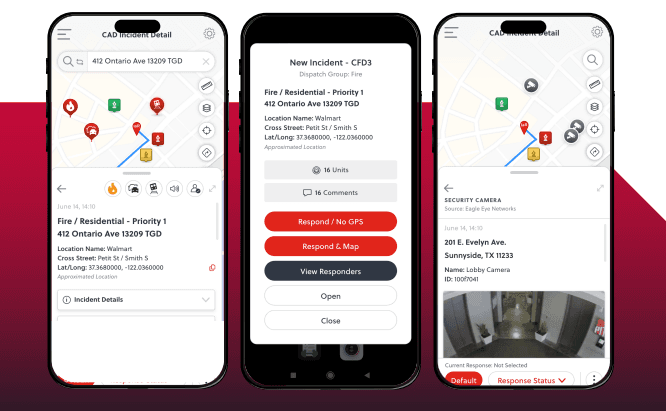

“I’m genuinely proud to work alongside the amazing team at Definity First. The projects that we are building together are reducing response times, improving situational awareness for responders, and ultimately saving lives. Kudos to everyone on the team, excellent work, and thank you for everything you’ve done.”

Engineering digital solutions that transform bold ideas into measurable business results.


© Sieena, Inc. All rights reserved
Stay in the know.
Subscribe to our newsletter for insights and updates.
Engineering digital solutions that transform bold ideas into measurable business results.
© Sieena, Inc. All rights reserved
Stay in the know.
Subscribe to our newsletter for insights and updates.
Engineering digital solutions that transform bold ideas into measurable business results.
© Sieena, Inc. All rights reserved
Stay in the know.
Subscribe to our newsletter for insights and updates.
Engineering digital solutions that transform bold ideas into measurable business results.
© Sieena, Inc. All rights reserved
Stay in the know.
Subscribe to our newsletter for insights and updates.